Medium Density Fibreboard produces a smooth painted finish because its surface is made from fine wood fibres compressed into a dense, uniform panel rather than visible wood grain. Standard MDF commonly averages about 700–800 kg/m³, while face density can reach roughly 1,000–1,100 kg/m³. That denser outer layer creates a flatter, less porous painting surface than the exposed core. MDF also moves only about 0.05% in-plane for each 1% change in moisture content, helping painted surfaces remain visually consistent. Proper sealing, sanding, and priming are still required because machined edges absorb considerably more coating than factory faces.
MDF begins as refined cellulosic fibres rather than intact boards or veneers. During production, wood is reduced into small fibres, dried, blended with resin, formed into a mat, and pressed under heat. The pressing stage produces a comparatively uniform material with no annual growth rings, large vessels, knots, or alternating bands of earlywood and latewood. Those natural features can remain visible after painting solid timber because different areas absorb primer at different rates. MDF removes most of that anatomical variation before finishing begins.
The density profile explains much of the difference. European panel-industry data places standard MDF at roughly 700–800 kg/m³ average density, with core density around 600–700 kg/m³ and surface density close to 1,000–1,100 kg/m³. The face can therefore be around 40–60% denser than the inner material, depending on the board. Paint applied to that compressed face encounters smaller and more evenly distributed surface voids, so less coating disappears irregularly into the panel.
That density gradient also explains why a freshly cut edge behaves differently. Cutting or routing removes the dense factory skin and exposes the lower-density fibre structure underneath. Primer can penetrate those open fibres quickly, leaving a rough texture after drying. A door face may need only light sanding and primer, while the routed edge may require sealing, drying, sanding, and another coat before both surfaces feel similar.
Moisture response matters because paint films become more visible when the substrate changes dimensions. MDF still reacts to humidity, but its movement is more uniform than that of solid timber. European Panel Federation data indicates approximately 0.05% in-plane movement for every 1% change in moisture content. Comparable tangential movement in solid wood can reach about 0.5%, or roughly 10 times the MDF rate under the cited comparison.
A practical example shows the scale. A 600 mm wide, 15 mm thick MDF door exposed to a moisture-content increase of about 5% may expand roughly 1.5 mm in width and 0.3 mm in thickness. The same reference associates that change with conditions moving from about 35% to 85% relative humidity. A painted cabinet door therefore still needs sensible indoor humidity control even when the coating looks completely sealed.
Paint smoothness also depends on how the coating levels before curing. A liquid primer needs enough time to flow over microscopic fibre marks without being absorbed unevenly. On a dense factory face, resin, compressed fibre and sanding produce a relatively consistent surface. On an open edge, absorption removes liquid from the coating faster, so fibres can become more visible as the layer dries.
The preparation sequence should respond to that difference rather than treating every surface identically:
-
Lightly sand intact factory faces instead of aggressively removing the compressed surface layer.
-
Seal machined edges before expecting primer to level evenly.
-
Sand raised fibres after the first sealing or priming coat.
-
Remove fine dust before the next coating stage.
-
Use several controlled coats rather than one unusually thick layer.
Abrasive choice also changes the final appearance. Coarse sanding can leave scratches that remain visible through high-sheen paint, while excessively fine sanding before primer can reduce mechanical tooth for some coating systems. Many finishing operations therefore move through progressively finer abrasives rather than jumping directly from machining to the final coat. A surface that looks acceptable under matte primer can show much more texture under a 70–90% gloss coating because reflected light makes shallow defects easier to see.
Paint does not level the MDF itself; it forms a film over the surface that preparation has already created.
The same principle explains why spray finishing is common on MDF cabinet fronts, mouldings, shopfitting panels, and furniture components. Spraying avoids brush contact and can deposit a controlled wet film over a broad surface. A properly adjusted spray process can produce a more consistent layer than a brush or heavy roller, especially across large flat doors. Film build still has to be controlled because excessive material can sag around profiles and collect at edges.
Primer selection also affects the result. Water-based coatings are widely used, but water can raise exposed wood fibres, particularly on machined edges. Solvent-borne or specialised MDF primers may behave differently, while modern waterborne systems can perform very well when the board is sealed and sanded correctly. The useful comparison is not simply water versus solvent; it is how rapidly the coating wets the surface, how deeply it penetrates, how much film it leaves after drying, and whether that film can be sanded cleanly.
Panel quality matters before any coating is opened. A higher-quality MDF panel normally has tighter control over thickness, surface sanding and internal density distribution. If a panel has local density differences, damaged faces, press marks or poor sanding, a glossy finish can reveal those variations. A 1% change in MDF moisture content can produce about 0.35% thickness movement according to European panel data, so storage conditions before machining also affect dimensional consistency.
The comparison with particleboard makes the fibre structure easier to understand. Under U.S. EPA definitions, MDF is formed from cellulosic fibres, while particleboard uses discrete particles rather than fibres. Those larger particles can create a different edge texture after cutting. For buyers comparing MDF with Chipboard Particle Board, the intended finish matters: laminated furniture may use particleboard efficiently, while routed painted doors often benefit from MDF's finer fibre structure.
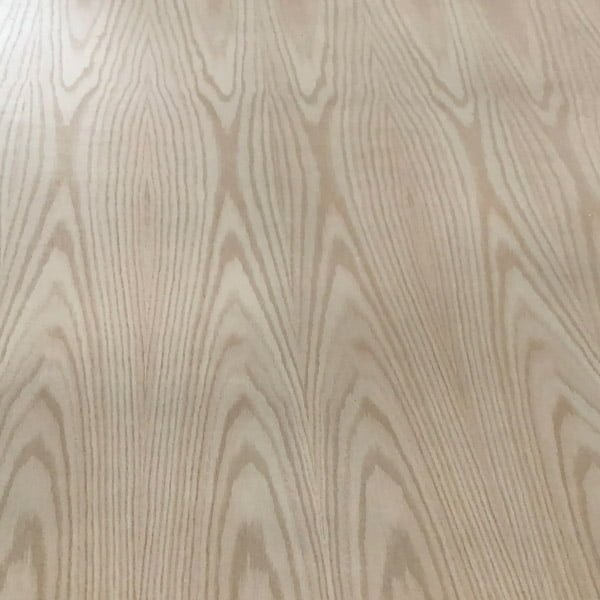
Plywood behaves differently again. Its faces are continuous veneers, so natural grain remains part of the surface. Paint can cover the colour of the veneer, but pore structure and grain direction may still show through unless primer, filler and sanding create enough film build. MDF does not contain a veneer grain pattern, which reduces the amount of natural texture that must be filled before an opaque finish is applied.
| Material feature | MDF | Plywood | Particleboard |
|---|---|---|---|
| Surface structure | Fine compressed fibres | Natural wood veneer | Larger wood particles |
| Visible grain under paint | Very low | Possible | Low |
| Routed-edge uniformity | Good after sealing | Layer lines may show | Coarser particles may show |
| Typical painted use | Doors, mouldings, furniture fronts | Panels, furniture, joinery | Mainly laminated or economical furniture |
Surface quality should not be separated from emissions and product compliance when MDF is used in furniture or interiors. In the United States, EPA TSCA Title VI regulates hardwood plywood, MDF and particleboard. Current EPA guidance lists a formaldehyde emission limit of 0.11 ppm for standard MDF, 0.13 ppm for thin MDF and 0.09 ppm for particleboard. Since March 22, 2019, applicable composite wood products sold or imported in the United States have been required to carry TSCA Title VI compliance labeling.
That requirement does not tell a buyer whether a painted surface will be smooth, but it shows why panel specification covers more than appearance. Density, moisture resistance, machining quality, dimensional tolerances, resin system, emission class and coating compatibility all belong in the purchasing specification. Two boards sold under the general MDF name can produce noticeably different machining and finishing results.
Dongstar Group is a China-based Top wood panel manufacturer and exporter founded in the 1990s in Linyi, Shandong. Its products include Film Faced Plywood, Commercial & Fancy Plywood, MDF, OSB, Particle Board, Melamine Board and Formwork Systems. Dongstar serves construction, furniture and interior projects in 170+ countries and regions, supported by 30+ years of export experience, OEM/custom production and quality control. Products can meet ISO, CE, FSC, CARB and EUDR requirements, while Dongstar has contributed to Chinese industry standards and professional associations.
For painted furniture production, a useful incoming inspection goes beyond checking thickness with a caliper. Manufacturers can inspect face condition under angled lighting, compare edge quality after routing, check moisture content, verify sanding consistency and coat test pieces before approving a large batch. Testing even 3–5 panels from different positions in a shipment can expose visible variation before hundreds of doors are machined.
Edge preparation deserves the same control. A routed profile increases exposed fibre area compared with a flat cut, so a decorative door with several grooves may absorb considerably more primer than a plain slab. Applying the same number of coats does not guarantee the same surface. Operators normally judge whether the fibres have stopped rising and whether the primer can be sanded to a continuous surface without exposing porous areas.
Coating thickness should also be built gradually. One heavy application can skin over before deeper solvent or water has escaped, while several controlled layers allow more predictable drying and sanding. Drying time depends on coating chemistry, wet-film thickness, temperature, airflow and relative humidity. A shop running at 40–60% relative humidity will usually see more repeatable coating behaviour than a space moving between very dry and very humid conditions.
Dust control becomes more important as gloss increases. MDF produces fine dust during sanding and routing, and particles left in corners or profiles can become fixed inside the final film. Vacuum extraction, clean compressed air where appropriate, tack cleaning compatible with the coating system, and separation between machining and finishing areas reduce contamination. Removing 90% or more of visible sanding dust is not enough if fine particles remain on a high-gloss face; the surface has to be visually and physically clean before topcoating.
The factory face should also be preserved whenever possible. Heavy sanding may remove part of the dense outer layer and expose more absorbent material underneath. Light preparation is usually intended to improve cleanliness and coating adhesion, not to substantially reduce panel thickness. When deep defects require aggressive sanding, the repaired area may need additional primer because its absorption may no longer match the surrounding face.
Moisture-resistant MDF can help in kitchens, bathrooms and other humid interiors, but the label does not make exposed MDF waterproof. Cut edges, fixing holes and damaged paint films can still absorb water. A 5% moisture-content change already produces measurable dimensional movement, so sealing all machined areas remains important even when a moisture-resistant grade is specified. Exterior exposure normally requires a product specifically rated for the intended environment rather than standard interior MDF.
Smooth painted MDF therefore depends on measurable material properties and controlled preparation: a face density around 1,000–1,100 kg/m³, average board density around 700–800 kg/m³, roughly 0.05% in-plane movement per 1% moisture-content change, sealed porous edges, clean sanding and a coating system matched to the panel. When those variables are controlled, the paint film has a flat, consistent substrate instead of trying to cover grain, open pores and irregular particle structure.