Switching Platforms Without Losing Your Routine
What moves with you when you change platforms is a habit, not a history: the sessions a week, the minutes per session, the tone you write in. Sixteen sessions a month at half an hour each is 8.0 hours, and that figure — not your saved list — is the thing worth rebuilding on the other side.

Key takeaways
- Write your habit down in numbers before switching — sessions a week, minutes a session, typical turn length.
- Carry the filters and the vocabulary, not the bookmarks. A working search query is worth more than thirty saved names.
- Test three cards rather than thirty. Auditioning in bulk produces a bad first impression on both sides.
- Expect to lose continuity. Earlier scenes usually stay where they were written, so plan the first session as a fresh start.
Inventory the habit, not the account
Begin with four numbers: sessions per week, minutes per session, average length of your own turns, and how many characters you actually opened last month rather than merely saved. Those four describe your routine far more accurately than a plan name or a subscription category, and they are the only inventory you can rebuild anywhere.
Then write a second, shorter list: the tone you prefer, the interaction style that suits how you write, and any tag whose meaning you had to learn. That vocabulary is the slowest thing to acquire on a new platform, and it is the reason a switch often feels worse in week one than in week three — you have your old vocabulary and none of the new one.
Rebuild in the order that pays off fastest
Start with filters, because they determine what you see. Set the content filter, pick the category you actually read, and add one broad and one narrow tag. This takes minutes and immediately reproduces the shape of your old browsing, which removes most of the disorientation of a new catalogue.
Then rebuild the shortlist — three characters, chosen from a filtered result set rather than a chart, and tested with a short session each. Only after that is it worth tuning the smaller preferences: how long your turns are, whether you write scene detail, and what time of day you read. Attempting all of it in the first evening is the standard reason a switch is abandoned.
| What you have | How to carry it | What will not transfer |
|---|---|---|
| Session rhythm | Write down sessions per week and minutes per session, then keep them | Nothing — the rhythm is yours |
| Filter vocabulary | Recreate the query on the new search page and save it | Tag names, which differ between catalogues |
| Shortlist | Pick three cards and test each briefly | Saved lists and their notes |
| Interaction preferences | Describe them in your own words and check them against new cards | The accumulated habits of a long-running character |
| Continuity of a story | Summarise the premise in two lines and open with it | Earlier scenes, which remain where they were written |
A two-week trial is the last piece of the plan. In week one, work at your old rhythm with the new filters and three test characters; in week two, add a fourth only if the first three are still interesting. At the end of the fortnight you will know two things that no comparison page can tell you: whether the register matches, and whether the rhythm survived the move. If both did, the switch is finished and nothing else needs deciding.
Worked example
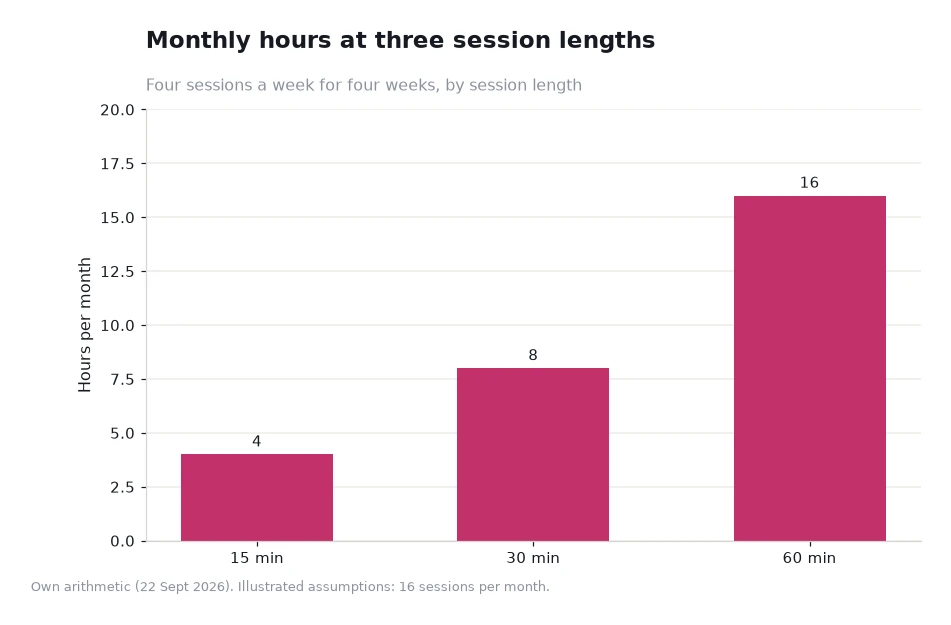
Convert the routine into hours so the target is explicit. Sixteen sessions a month — four a week across four weeks. At fifteen minutes each, that is 4.0 hours a month. At thirty minutes, 8.0 hours. At a full hour, 16.0 hours, about 3.7 hours a week.
Why do the arithmetic? Because it tells you what to protect. If your real habit was 4.0 hours a month, a switch that costs you an evening of setup has already consumed half a month of the routine it was meant to preserve, and the sensible approach is to change little and test quickly. If your habit was 16.0 hours, a single lost evening is 6% of the month and worth spending on filters and a shortlist. The same migration, in other words, is a different project depending on the size of the habit underneath it.
One last check before committing is worth the two minutes: read the new platform's own description of what it offers and mark every claim you can test in your first week. Claims about adaptive replies, customisable characters and privacy are all testable with three short sessions, and a migration goes better when you have decided in advance which of them you are checking rather than discovering them by accident.
Three mistakes that make a switch feel worse than it is
The first is bulk importing expectations. Opening twenty cards in a new catalogue and judging it on all of them produces a superficial read of each and a strong impression of noise. Three proper trials tell you more.
The second is expecting a new character to behave like the one you were used to. Continuity is built by writing, not transferred by copying a description, so the first sessions on a new platform are always setup sessions. The third is judging the service by its marketing language rather than its mechanics: read what a page promises and then check whether the product delivers that specific thing, rather than comparing it against a memory.
Set expectations from the product description
A useful habit before committing is to read the platform's own description of what it offers and test whether that is what you came for. Crushon's ai porn chat page foregrounds three things: characters you can customise, a private and secure environment, and replies that adapt as a conversation develops. If those three match your old routine, the switch is mostly a matter of rebuilding filters and testing a small shortlist.
The practical details are worth checking before you start rather than after. Its FAQ entry on what Porn Chat AI means describes the format in one paragraph, which is enough to tell whether your expectations line up, and the character search page is the first place to rebuild your query. If a long-running story matters to you, write the two-line premise before you open anything, and start the new chat with it — that single step recovers more continuity than any amount of browsing. The AI chat blog carries background if you want to understand the mechanics before settling in.
Frequently asked questions
Can I move a saved list to a new platform?
Expect to rebuild it. Filters and vocabulary travel in your head; a saved list is tied to the catalogue it came from.
How long does a switch take to feel normal?
About two to three weeks of your usual rhythm. Most of that time goes on relearning tag vocabulary rather than on the interface.
Should I keep both platforms for a while?
Running both splits a small habit in half. If your monthly hours are modest, pick one and commit for a fortnight before deciding.
Write it down, then move
Spend ten minutes recording your four numbers and your vocabulary list, rebuild filters first, and test three characters with short sessions. Keep your usual rhythm rather than expanding it, and give the new platform a fortnight before judging it. That is the whole migration — and if the habit survives the fortnight, it was never the platform holding it together.
References: the platform's AI porn chat and FAQ wording, read 22 Sept 2026[1]. Session-hour figures are illustrative arithmetic, not measured use. Read 22 Sept 2026. Content for adult readers, 18+.