Sport Utility EVs: Where the Segment Is Heading
The electric SUV stopped competing on battery size and started competing on platform voltage. In the Australian line-up that shift is already visible: the New G6 and the X9 both sit on a full-domain 800V silicon-carbide platform and both publish a 10-80% charge in 12 minutes. The interesting question is what that does to the shape of the category over the next two years.

Key takeaways
- Platform voltage, not battery size, is the specification buyers now compare.
- A 5C battery with a 12-minute 10-80% window changes how a long drive is planned.
- Coupé SUVs and seven-seat MPVs are converging on the same charging hardware.
- The published strategy points to five new models during 2026 and Navigation Guided Pilot from 2027.
The platform is the new headline
Two years ago a brochure led with kilowatt-hours. Now the leading specification is the architecture underneath: the New G6 carries what the manufacturer calls a full-domain 800V high-voltage silicon-carbide platform with 5C supercharging, and the X9 uses the same approach. Silicon carbide matters because it wastes less energy as heat, which lets the car hold a high charging rate for longer instead of tapering early in the session.
That single change reshapes the buying conversation. Range still matters, and the published ceilings are up to 525 km for the New G6 and up to 580 km for the X9 on the WLTP cycle, but a driver who can refill the useful 10-80% band in 12 minutes stops treating range as the primary safety margin. The stop becomes the unit of planning instead of the full battery.
Body shapes are converging on the same hardware
The other visible trend is that body style no longer decides the technology. A coupé SUV and a boxy seven-seat MPV now share a platform, a charging window and a warranty. The New G6 leans on a fastback silhouette, a long front overhang and a full-width integrated light bar, while the X9 uses active rear-wheel steering and dual-chamber air suspension with an AI chassis that reads obstacles up to 30 m ahead and adjusts damping, plus a one-touch electric fold-flat third row and cargo space expanding to 2554 L.
Both are described as backed by Euro NCAP five-star safety, both publish the same 12-minute window, and both fall under the same ownership terms: seven years or unlimited kilometres on the vehicle for private use, eight years or 160,000 km on key parts, and servicing every 12 months or 20,000 km, whichever comes first.
| Trend | What changed | Published example |
|---|---|---|
| Architecture | Voltage replaces capacity as the headline | Full-domain 800V SiC platform |
| Charging | Short, high-power stops instead of long waits | 10-80% in 12 minutes |
| Body style | Coupé SUV and MPV share the same hardware | New G6 and X9 |
| Range ceiling | Enough for touring without being the selling point | Up to 525 km and up to 580 km WLTP |
| Strategy | Model count and driver assistance both expanding | Five models in 2026, NGP from 2027 |
What a 5C rating means in plain numbers
A C-rating describes how fast a battery can be charged relative to its own capacity, so 5C is shorthand for a battery built to accept power quickly rather than a number you will ever see on a dashboard. Take the published window and work it out: 10% to 80% is a span of 70 percentage points, and 12 minutes is one fifth of an hour. Dividing 70 by 0.2 gives an average rate of about 3.5C across the band, with the peak sitting higher at the start of the window and tapering near the end. That is the arithmetic behind a headline that otherwise sounds abstract.
Why the platform matters away from the highway
Not every benefit of a higher-voltage platform shows up on a road trip. At home the car charges on a Type 2 (AC) point overnight, which is where most kilometres will come from, and the schedule can be set for off-peak hours. The charge flap sits on the right rear quarter panel and opens with a press on the top-left corner, and the cars accept most public Type 2 and CCS2 (DC fast) chargers. Some Tesla Supercharger sites in Australia are open to non-Tesla CCS2 vehicles, and the published advice is to confirm site compatibility in the Tesla app before relying on one for a planned stop.
Warranty remains part of the trend story, because a platform that charges hard has to be backed for a long time. The published terms are seven years or unlimited kilometres on the whole vehicle for private use, eight years or 160,000 km on the key parts that name the traction battery, battery management system, drive motor and intelligent power unit, five years on paint, seven on anti-corrosion and seven years of roadside assistance from first registration, with servicing every 12 months or 20,000 km. In this segment those lines belong in the specification comparison, not in the paperwork that follows the decision.
Worked example: what the shift is worth in energy terms
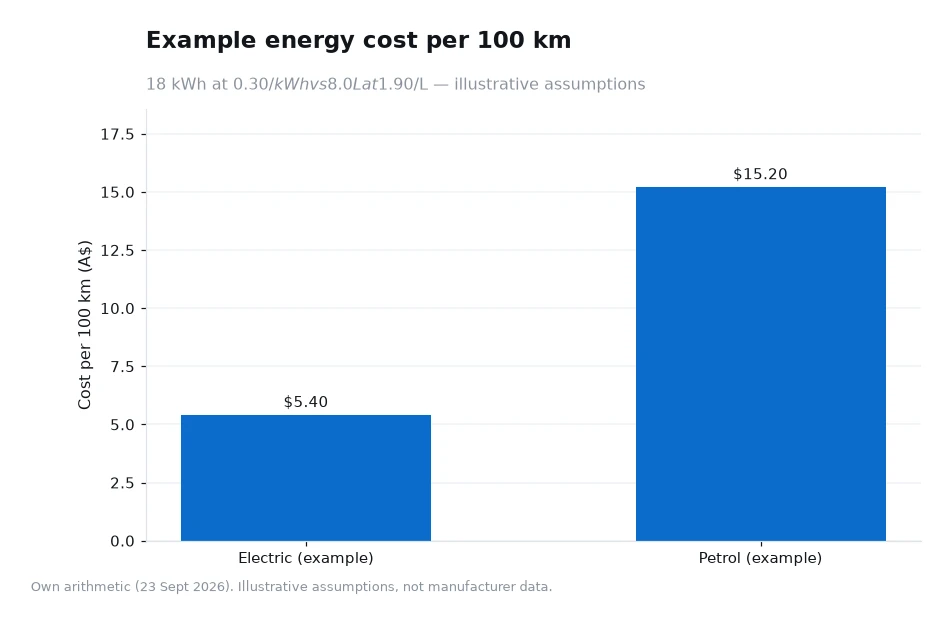
This is an example with assumed inputs, not a quoted cost. Take the chart assumptions beside this section: an electric car at 18 kWh per 100 km with electricity at $0.30 per kWh, and a petrol SUV at 8.0 L per 100 km with fuel at $1.90 per litre. The electric figure is 18 multiplied by 0.30, which is $5.40 per 100 km; the petrol figure is 8.0 multiplied by 1.90, which is $15.20 per 100 km. The gap is 15.20 minus 5.40, or $9.80 per 100 km.
Now put it on a monthly footing. Assume 1,000 km a month, which is 10 blocks of 100 km. The electric case is 10 multiplied by 5.40, or $54 a month; the petrol case is 10 multiplied by 15.20, or $152 a month. The monthly gap is $98, and over a year at 12,000 km it becomes 120 multiplied by 9.80, which is $1,176. Substitute your own tariff and your own fuel price if either assumption is unrealistic for your household.
Frequently asked questions
Is every new electric SUV moving to 800 volts?
Not every one, but the direction is clear in this line-up: both the New G6 and the X9 are published on a full-domain 800V silicon-carbide platform with a 12-minute 10-80% window.
Do seven-seat electric MPVs make sense in Australia?
For large households, yes. The X9 publishes up to 580 km of WLTP range, the same 12-minute rapid window, cargo space expanding to 2554 L and a third row that folds flat at the touch of a button.
What to watch next
Watch the charging hardware and the model count, not the badge. The published Australian strategy sets out five new models during 2026 and advanced Navigation Guided Pilot from 2027, which suggests the segment will keep moving towards shorter stops and more assistance rather than larger batteries.
For the specification behind this article, read the manufacturer's suv ev australia model pages, then compare the XPENG X9 if you need the extra row. The charging pages cover the connectors and the home equipment, which is the part of the switch most buyers underestimate.
One caveat applies to every number in this piece. WLTP range is measured on a laboratory cycle and the manufacturer's footnote says the figure depends on conditions, so 525 km or 580 km is a ceiling rather than a forecast for a loaded car on a windy highway. The charging figures carry their own conditions too, since a 12-minute window assumes a charger able to deliver the power the car asks for. Read both as the best case the hardware is built around, and leave a margin in the plan.
Platform, range, charging and warranty details come from the manufacturer's Australian pages and news items, read 23 Sept 2026; WLTP range depends on conditions, and the energy-cost arithmetic above is an illustrative example using the assumptions stated rather than manufacturer data.[1]