Outdoor furniture procurement is easier to compare when every supplier receives one brief covering intended exposure, configuration, finish, maintenance, packaging, and delivery. A patio chair, garden table, lounger, and shade structure may share a style but require different construction and evidence. Record the service environment before scoring quotes.
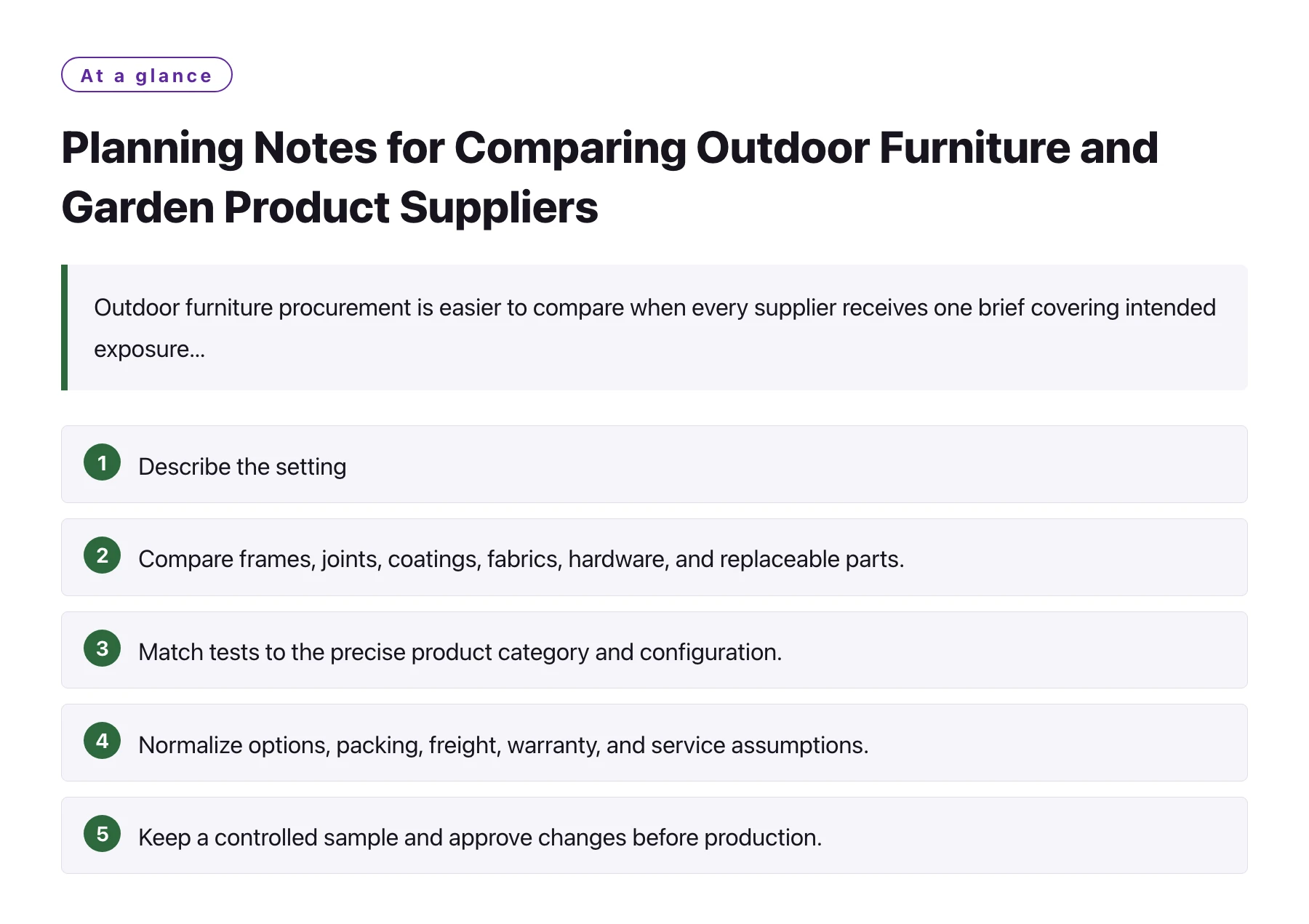
Key takeawaysDescribe the setting, expected use, exposure, storage, and cleaning routine. · Compare frames, joints, coatings, fabrics, hardware, and replaceable parts. · Match tests to the precise product category and configuration. · Normalize options, packing, freight, warranty, and service assumptions. · Keep a controlled sample and approve changes before production.
A consistent document review ties each claim and report to one controlled product, manufacturer, revision, and market.
1. Describe the service setting
State whether products are for residential gardens, hotels, restaurants, pool decks, public parks, or other sites. Record frequency of use, expected occupancy, storage conditions, direct sun, rain, salt or pool exposure, cleaning agents, and assembly requirements. A design used seasonally differs from furniture exposed every day.
Give suppliers the same finish schedule, site photos, installation constraints, and service expectations. Specify whether cushions stay outdoors or are brought inside. Identify maintenance responsibilities and planned replacement cycle where the project has one.
List the expected delivery window, batch size, replacement expectations, and whether products will be assembled on site. Include guest-access timing, loading access, and any restrictions on using adhesives, oils, or other maintenance products. These operational details can affect supplier selection just as much as appearance and unit price.
2. Specify construction by product type
For chairs and tables, record frame material, dimensions, tube or section details where required, joint and fastener design, feet, load path, and assembly. For loungers, include adjustment and locking positions. For parasols, define base, pole, opening mechanism, wind limitations, and whether the base is included.
Different materials require different evidence and care. For timber, identify species or approved equivalents and finish. For metal, state alloy or coating requirements. For plastics, identify the polymer, color, reinforcement, and exposed-weather requirements. Avoid accepting “all-weather” without defined conditions.
3. Review cushions and surface finish
For textiles, record composition, color, weave or coating, seam construction, closures, removable cover, foam, drainage, and care. For coatings, state substrate preparation, finish system, accepted color range, coverage, and inspection conditions. Agree on an approved sample under suitable lighting.
Check hidden and contact surfaces as well as the front face. Confirm whether hinges, welds, cut ends, feet, and underside areas receive equivalent protection. State how scratches, coating gaps, color variation, fading, or mildew will be evaluated and repaired.
4. Use standards only within their scope
ASTM F1988-99(2020) covers specified plastic outdoor chaise lounges with adjustable backs; its scope excludes upholstered chairs and other furniture types. It includes selected performance aspects and should not be used as blanket evidence for tables, parasols, or an entire garden range. Confirm current applicability with the technical owner. [1]
For each test report, confirm model, construction, specimen, standard edition, test condition, result, and limitations. A report for one frame, material, or product category cannot be generalized without a reasoned technical assessment. Separate safety, durability, and appearance evidence.
5. Compare samples and reports
Label samples with supplier, factory, product code, revision, materials, and sample status. Assemble with the quoted hardware and instructions; check alignment, stability, sharp edges, pinch points, locks, drainage, finish, and ease of cleaning. Record observations and dimensions against shared criteria.
If exposure or loading matters, define specialist test methods, conditioning, sample quantity, pass limits, and report owner. An indoor showroom check does not demonstrate season-long weather performance. Ask for evidence matched to the intended use rather than relying on generic claims.
6. Normalize the commercial offer
Put model, options, material, finish, cushion package, accessories, order quantity, tooling, sample charge, production lead time, minimum order, packaging, spares, warranty, and freight assumptions into a comparison sheet. Separate recurring price from one-time costs and list exclusions.
Compare delivered and maintained cost as well as unit price. Carton size, protection, assembly labor, replacement parts, and finish repair may change the project economics. Ask each supplier the same clarification questions and preserve written answers.
7. Protect approval through production
Approve a physical reference or controlled photo set tied to drawings, bill of materials, finish, hardware, labels, and packaging. State which items are appearance references and which have measurable criteria. Retain the reference so it is not altered by sunlight, moisture, or use.
Require written review before changes to plant, material, coating, fastener, textile, cushion, design, or subcontractor. Assign who can accept deviations, how a lot is identified, and which production or final checks are required before shipment.
8. Plan delivery and aftercare
Set packing rules for bulky or delicate items: surface protection, corner guards, hardware bags, carton labels, stacking, pallets, and moisture protection. Confirm assembly instructions, spare hardware, care guide, replacement part codes, and warranty contact are included.
For project delivery, coordinate receiving access, storage, assembly, and installation timing. Buyers considering JS Sourcing garden product sourcing can send suppliers one project brief and compare their manufacturing scope, samples, documentation, and commercial assumptions against the same checklist.
Sources
Frequently asked questions
What information should a garden furniture RFQ include?
List intended use, product configuration, materials, finish, cushions, dimensions, quantity, packaging, delivery, warranty, required evidence, and acceptable variation.
Does one outdoor furniture test cover a whole collection?
No. Confirm scope and exact product type; reports for one model or category may not cover other constructions.
How should outdoor finishes be compared?
Use named material and coating systems, color references, inspection conditions, care instructions, and an approved sample.
When should a new sample be requested?
Request one after changes that may affect construction, materials, finish, fit, safety, durability, or destination requirements.