IFRA compliance is not a certificate you hold, and it is not a step that happens at the end of a project. The IFRA standards are a library of use limits for specific fragrance materials in specific product types, and your job as a brand owner is narrower than it first appears: know which category you are selling into, get a documented statement from the supplier against the finished formula, and keep that statement with the version of the formula it describes.
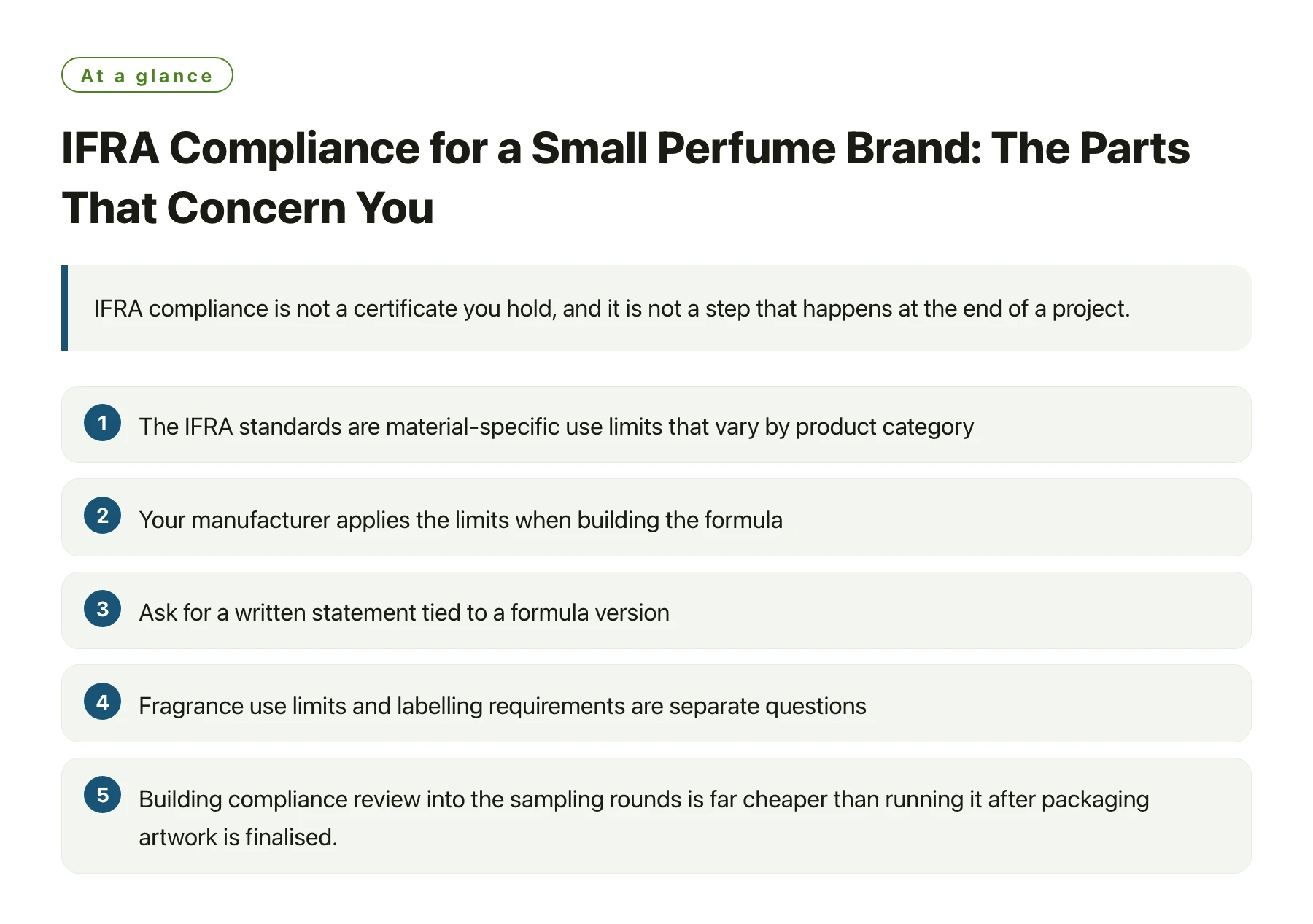
Key takeawaysThe IFRA standards are material-specific use limits that vary by product category, not a single pass or fail mark for a fragrance. · Your manufacturer applies the limits when building the formula, but the brand owner is the party accountable for the product placed on the market. · Ask for a written statement tied to a formula version, and check that the statement names the product category you are actually selling. · Fragrance use limits and labelling requirements are separate questions, so a formula can satisfy one and still need label changes for the other. · Building compliance review into the sampling rounds is far cheaper than running it after packaging artwork is finalised.
Most first-time fragrance founders meet IFRA compliance as a line item in a supplier questionnaire, usually a few weeks before a launch, and usually without a clear sense of what is being asked. The word compliance suggests a certificate, so the instinct is to request one.
That instinct leads to a dead end, because there is no single document called an IFRA certificate that covers a finished fragrance. What exists is a set of standards maintained by the International Fragrance Association, applied material by material, with limits that depend on how the product is used.
This article explains what those standards do, which parts of the work belong to the supplier and which belong to the brand, and the order in which to handle the whole question so it does not land in the same week as your packaging deadline. It is written for brands without an in-house regulatory function, and it deliberately avoids legal advice: the goal is to know which questions to ask and what evidence to keep.
What the IFRA standards are, and what they are not
The standards library exists because some fragrance materials carry use restrictions, typically expressed as a maximum concentration in a finished product, and those limits differ depending on where the product is applied and how much of it stays on the skin.
Understanding that structure explains almost every practical compliance question a small brand runs into, including the ones that look like inconsistencies between two products that seem similar.
A standards library, not a certificate
The International Fragrance Association maintains and publishes a standards library that sets how much of a given material may be used, and its limits are organised by material and by product category [1]. The library is a reference work, not an approval stamp, and that distinction shapes what a supplier can honestly give you.
A supplier can give you a written statement that a specific formula version complies with the applicable limits for a named category. It cannot give you a generic certificate, because compliance is a property of a formula in a category rather than of a company. When a manufacturer such as Guangzhou Xuelei Cosmetic Co., Ltd. issues that statement against a named version, treat it as an input to your own product file rather than as a replacement for it.
Voluntary in name, contractual in practice
The standards are maintained by an industry association rather than issued by a regulator, which sometimes leads founders to treat them as optional. In practice they arrive through the supply chain: manufacturers build formulas to them, retailers ask for confirmation, and buyers ask for documentation.
The association also publishes material on fragrance science and how safety assessment is carried out, which is useful background when you are trying to understand why a particular material carries a limit at all [2]. Reading that material is not a substitute for professional advice, but it makes you a better-informed client.
Why the category changes the answer
A fragrance used in a rinse-off product and the same fragrance used in a leave-on product are not assessed identically, because exposure differs. A body lotion, a fine fragrance spray, a candle and a shampoo do not share one limit.
So the first compliance task is not technical at all: it is writing down exactly what the product is and how it will be used. Everything downstream depends on that sentence being right.
The compliance questions a small brand has to answer
| Question | Who answers it | Evidence to keep on file |
|---|---|---|
| What category is this product? | The brand, in writing, based on how the product is used | A one-line product definition that matches the label and the intended use |
| Does the formula respect the applicable use limits? | The fragrance developer or manufacturer | A written statement naming the formula version and the product category |
| What has to appear on the label? | The brand, with input from the manufacturer and the market rules | The declared ingredient list for the finished formula at the approved version |
| Is any restricted material near its limit? | The manufacturer, on request | A short note listing materials with limited headroom, so a future revision is anticipated |
| Who is responsible in each market? | The brand, with a named entity per market where required | Contact details and documentation obligations for each market you sell into |
The middle column is the part founders get wrong most often. Manufacturers answer technical questions about the formula they built; they do not take over the brand's responsibility for the product as sold. Knowing which column each question belongs in prevents both false reassurance and unnecessary arguments.
The cheapest compliance work happens during sampling, not after it. Ask for the restricted-material statement at the same time you evaluate the second sample, while the formula can still move without touching artwork, purchase orders or a launch date. Brands that reverse this order end up paying for two versions of the same product: the one they designed and the one they could document in time. One email during round two is worth several weeks of rework later.
Where small brands lose the most time
The work is not complicated, but it is easy to sequence badly. Three patterns account for most of the delay, and each has a straightforward fix.
They also tend to appear together, which is why the fix is usually a change to project order rather than a change to the team.
Waiting for the finished formula to ask questions
Compliance questions asked after the formula is frozen can only produce two outcomes: confirmation, or a change nobody budgeted for. Asking earlier turns the same question into a design constraint.
The practical version is simple. Add one line to the development brief asking which materials in the proposed formula carry use restrictions and how much headroom remains.
Treating fragrance limits and labelling as one task
They are related but separate. A formula can sit comfortably inside every applicable use limit and still require a declaration change, because labelling rules are about the presence of certain substances in the finished product above set thresholds.
Ingredient databases maintained for the European market illustrate the gap: they catalogue how substances are named and used in cosmetic products, which is what a label declaration draws on, rather than what a fragrance use limit covers [3]. Confirm the declaration list against the approved formula version and keep them together.
Assuming one market's rules cover the others
A product cleared for one market is not automatically cleared everywhere. Labelling conventions, notification duties and the identity of the responsible entity differ, and a fragrance brand selling into several markets has to track those differences per market.
The efficient approach is to build a single documentation pack, then note per market what has to be added. That keeps the pack stable while the market annexes change.
A sequence that keeps compliance off the critical path
- Define the product in one sentenceWrite what the product is, how it is applied and whether it stays on the skin, then use that sentence everywhere.
- Ask about restrictions at briefing stageRequest the restricted-material picture with the first sample so any constraint becomes a design input rather than a late change.
- Get the statement against a versionAsk for a written compliance statement that names the formula version and the product category, and store it with that version.
- Confirm the declaration listOnce the formula is frozen, have the manufacturer confirm the declaration-relevant details and check them against your label artwork.
- Note the near-limit materialsKeep a short internal note of materials with little headroom, so a future revision or a new market can be planned rather than discovered.
- Review before each market launchTreat every new market as a short review of documentation obligations rather than as a repeat of the entire exercise.
Sources
- IFRA Standards Library (International Fragrance Association) —— The IFRA Standards Library lists the restrictions the fragrance industry applies to individual fragrance ingredients, based on safety assessments; it is the reference point for compliant fragrance formulation.
- IFRA: Safe Use and Fragrance Science —— IFRA's explanation of how fragrance materials are scientifically assessed for safe use and how those conclusions are applied by the industry.
- EU CosIng — Cosmetic Ingredient Database (European Commission) —— The European Commission's CosIng database of cosmetic ingredients, listing ingredient functions, restrictions and labelling requirements under EU cosmetics law.
Frequently asked questions
Is IFRA compliance required by law?
The standards are published by an industry association rather than by a regulator, so they are not legislation in themselves. They become effectively binding through supply agreements, retailer requirements and the safety assessment that supports a product. In many markets, the finished product still has to satisfy local cosmetics law as well.
Can my manufacturer give me an IFRA certificate for my fragrance?
Usually what you receive is a written statement that a specific formula version conforms to the applicable limits for a named product category. That is more useful than a generic certificate because it is tied to a version and a use. Ask for the version number and the category to appear on the statement itself.
What happens if a fragrance material becomes restricted later?
The formula may need to be revised to stay within the new limit. This is why it is worth asking which materials in your formula have little headroom, and why you should agree a change-notification obligation with your manufacturer so you hear about a revision before it affects a production batch.
Do I need a safety assessment as well?
Fragrance use limits are one input to the safety documentation of a cosmetic product, not the whole of it. Most markets expect a product-level safety assessment, prepared by a qualified assessor, covering the finished formulation, its packaging and its intended use. Treat the fragrance statement as a component of that file.
How long should I keep compliance documents?
Keep them at least for as long as the product is on the market and for a reasonable period afterwards, and store each statement alongside the formula version it describes. If you later change formula, packaging or market, the old statement stays valid for the old version, which is exactly why version control matters.